When the Fool Took Centre Stage in European Comedy
When the fool took centre stage in European comedy, comic servants moved from interrupting authority to driving plots, a distinction that helps shape stronger scenes.
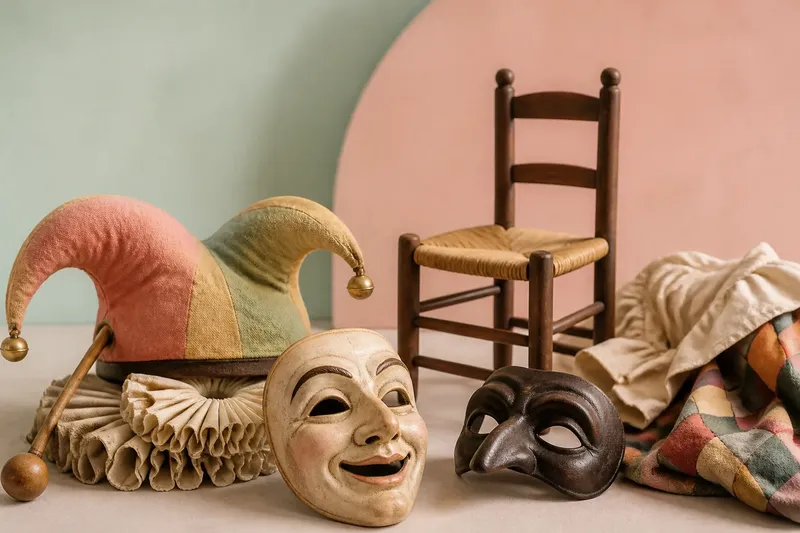
The common mistake in tracing the comic fool is to treat the figure as one character with one origin. That costs the story its useful distinction: a fool can interrupt a scene, or become the reason the scene moves at all. In European court performance and commedia dell’arte, those functions took different forms; neither tradition supplies a single moment when the fool became central.
Different dramatic jobs
“Fool” is a broad dramatic term, not the name of one fixed role. A court fool, a comic servant and a clown may all unsettle social order, but their status, performance conventions and relationship with the audience differ. They should not be arranged as successive stages in a universal history.
In European courts and households, jesters or fools might entertain a patron and, within the limits of that relationship, tease or contradict people with greater status. The setting matters: the performance depended on a particular household and the patron’s tolerance. It is more precise to describe a conditional licence to mock than to treat the fool as an independent critic operating without risk.
For a writer, the useful question is concrete: why is this character in the room, and what restricts what they can say? A role with access but no limits has little dramatic tension.
Servants drive action
Commedia dell’arte is a distinct Italian theatrical tradition, associated with professional companies, recurring character types and masked performance. Within it, zanni were comic servant figures. Their portrayals varied, but hunger, schemes, mistakes and opportunism could propel the action. The servant was not merely there to decorate a scene with jokes: a plan to get food, money or advantage could set events moving.
This is a different route to centrality from the court fool’s licensed interruption. A servant may lack authority but possess practical access to the people and objects around them. Their attempts to meet an immediate need create consequences, often for themselves as well as their social superiors.
Give the comic figure a desire or obligation that makes them act. Then let the action produce trouble the character must address.
From disruption to plot
A comic protagonist does more than make observations. Their decisions organise the action: remove them, and the plot would have to change. The character need not be secretly wise. They may understand one part of a situation, misread another, and act on both at once.
Say a writer begins with an invented scene in which a caretaker is ordered to arrange chairs for a meeting. The caretaker wants to finish quickly so they can leave, but moves the chairs into a formation that puts the chairperson at the back. The resulting confusion is visible, and the caretaker’s practical aim—not a string of detached jokes—has caused the next problem.
That small mechanism can be checked in rehearsal:
- If the character’s goal is clear from their actions, then keep it; if not, give them a visible task or object to pursue.
- If their decision changes what another character must do, then retain its consequence; if not, make the decision affect the scene’s immediate action.
- If the character can leave without changing the plot, then strengthen their obligation or desire; if not, the role already has a reason to lead.
- If the misunderstanding is legible to the audience, then let it develop; if not, clarify what the character sees and what they have missed.
- If the character’s mistake creates a new obstacle, then use that obstacle; if not, connect the mistake to a practical consequence.
- If another character could perform the same interruption with no change, then give the fool a distinct access or limitation; if not, the role has a specific dramatic position.
What makes the fool lead?
What separates a fool from a clown?
A fool is a broad dramatic function: apparent folly gives a figure room to disrupt or expose others. “Clown” can refer to particular performance traditions and techniques, often shaped by physical action, costume and audience relationship; the terms overlap but are not interchangeable.
Why can a fool criticise authority?
Low status, unusual behaviour or a tolerated licence may give the fool room to say what a respectable character would avoid. That permission remains conditional, and the joke can reveal the fool’s vulnerability as well as authority’s weakness.
How does a fool become the protagonist?
Give the character a desire or obligation that shapes events, then let their decisions carry consequences. The plot should change if the character leaves.
Does every comic scene need a fool?
No. The role is useful when a scene needs someone to disrupt its social order or drive events through comic decisions. If another character already does that work, a second fool may simply repeat the function.
Choosing the form
A masked character type, a clown’s physical performance and a comic protagonist ask the audience to read different things. A mask or costume can identify a role through convention; physical comedy depends on timing and visible action; a protagonist’s centrality depends on sustained desire and consequence. These approaches can overlap, but a scene should make its main source of attention clear.
For physical comedy, a prop only helps if the audience can read what changes. If a character’s burden grows, the object must remain visible and the character’s difficulty understandable from across the room. Otherwise, the prop is just an extra object to move.
Questions about comic fools?
Did the fool take centre stage in one period?
There is no single period that accounts for every comic fool becoming a lead. Court fools and commedia dell’arte servants occupied distinct settings and could command attention in different ways.
Were zanni always clever servants?
No single description fits every zanni portrayal. They could be hungry, mistaken, resourceful or opportunistic, and their schemes could create the action rather than merely comment on it.
What gives a fool dramatic authority?
Access, a tolerated licence or a practical role can put the character near the action. A clear limit on that access keeps the permission from feeling effortless.
Can a fool lead without being the smartest character?
Yes. The character can lead through a strong need and consequential choices rather than superior insight. A partial understanding can be more productive than constant cleverness.
When the fool took centre stage in European comedy, there was no single promotion from servant to star; different traditions gave comic figures different kinds of dramatic power. For a new scene, decide whether the character’s main force is permission to interrupt, practical access, or a desire that drives the plot. That choice will tell you what the audience should watch for before the first joke lands.