The Second Meaning Hidden in a Familiar Phrase
A familiar phrase punchline works when its ordinary meaning sets a clear expectation, then a precise turn gives the same words a second, comic sense.
The most common mistake with a familiar phrase punchline is to make the phrase do all the work. A proverb or everyday expression may sound promising, but if the setup has not made its ordinary meaning matter, the final reinterpretation feels like a pun pasted onto a sentence. The cost is a joke whose cleverness arrives before the audience has a reason to care.
The stronger version lets a phrase begin as a useful bit of everyday language, then reveals that its words also belong to the situation in a more literal or unexpected way. The audience does not simply hear a new meaning; it has to revise the meaning it had just accepted. That small mental correction is the turn.
Build a clear expectation
Start by choosing the phrase, then write down the meaning an audience is likely to hear first. “Keep your eyes peeled” usually means stay alert, not remove a layer of skin from one’s eyes. That familiar, figurative reading is the setup’s raw material.
Next, give the phrase a reason to appear. A character might be preparing for a difficult task, offering advice or describing a problem. The setup should establish a situation in which the ordinary meaning makes sense, without pointing so plainly at the second meaning that the audience arrives there early.
Useful setups tend to be economical. If the joke needs a long explanation of what the expression normally means, the phrase may be too obscure or the scene may not support it. If the setup contains several unrelated details, the eventual turn has to fight for attention.
Let the phrase sound natural before you ask it to behave strangely.
Choose the kind of turn
There are several ways to expose a second meaning. They suit different voices and situations; none is automatically cleverer than the others. The right choice depends on how much attention the joke can spare for wordplay and what the character would plausibly say.
Literal interpretation
This approach treats an idiom as though its words describe physical reality. It suits a visual or story-based joke, because the second meaning can be made concrete. Its main risk is predictability: once the audience recognises the expression, an obvious physical enactment may arrive before the punchline.
Contextual reinterpretation
Here, the phrase keeps its usual wording but acquires a different sense because of what has just been revealed. This suits dialogue and characters whose ordinary concerns can tilt a familiar expression in an unexpected direction. It asks more of the setup: the new context must be clear enough to make the shift legible, but not so signposted that it gives away the answer.
Dry correction
A character can respond to an expression by objecting to one word or taking its wording with irritating precision. This suits a fussy, literal-minded or self-interested voice, provided the character has a reason to care. Without that motive, the line can sound like the writer displaying a pun rather than a person responding to a situation.
Say a character is told to “break a leg” before a performance. In an invented scene, they might reply, “I was hoping to keep both intact for the dance.” The familiar well-wish first lands as encouragement, then “break” turns into a practical concern; the expected observable result is a brief pause as the audience catches the altered sense. A subtler version could let a later detail about the dance supply the turn, rather than putting the explanation in the reply.
Place the turn late
A punchline’s final words matter because they control when the audience can complete the reinterpretation. Compare “I took the phrase ‘on thin ice’ literally and stepped carefully” with “I stepped carefully; the ice was thin.” The second arrangement holds the relevant information back. The sentence does not need a dramatic flourish; it needs to release its clue at the point where the first reading can no longer hold.
That does not mean hiding every useful detail. The audience must be able to connect the phrase to the situation without stopping to decode a puzzle. A good test on the page is to remove any explanatory sentence after the punchline. If the joke collapses without it, the turn may not be doing enough.
Read the line aloud as well. A phrase can be familiar in print but clumsy in speech, or its second meaning may depend on emphasis that makes the trick obvious too soon. The spoken version should sound like a sentence the character might actually use.
Which approach fits?
Use this comparison to decide how much the joke should ask the audience to infer:
- Choose literal interpretation when the second meaning can become a clear image or action, and the scene has room for it.
- Choose contextual reinterpretation when a new fact about the situation can quietly change how the phrase is heard.
- Choose dry correction when the character’s temperament gives them a credible reason to seize on the wording.
For a quick line, contextual reinterpretation often needs the fewest moving parts. For a scene with a visible consequence, literal interpretation can give the phrase somewhere to go. Dry correction is most useful when the character’s response tells us something beyond the writer’s interest in wordplay.
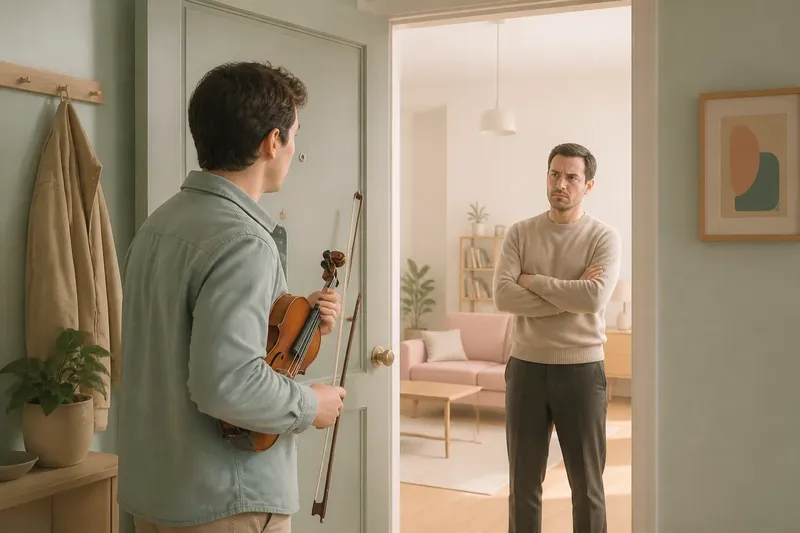
Imagine a character who has been advised to “face the music” before meeting an angry neighbour. In an invented scene, the character walks into the room carrying a violin, having misunderstood the warning. That version suits a visual beat, but it also makes the character’s mistake explicit. If the scene instead reveals that the neighbour is a musician, the same phrase may gain a quieter contextual turn. Choose the version that serves the scene’s scale, not merely the phrase’s pun potential.
Questions about phrase turns?
How familiar should the phrase be?
It should be recognisable enough for its ordinary meaning to arrive without explanation. If only a few readers know the expression, establish its sense through the scene or choose a more widely understood phrase.
Can the phrase appear in the punchline?
Yes, especially when its placement helps the audience hear both meanings at once. But repeating it can feel like a prompt, so consider whether the setup has already established the wording clearly.
What if the audience spots the second meaning early?
Give the phrase a more convincing ordinary context, or use a less predictable consequence of the second reading. If the turn is still visible too soon, the phrase may be carrying more familiarity than surprise.
Does every phrase need a literal image?
No. A change in context or a character’s precise correction can create the shift without staging the words as an object or action. Use a literal image only when it adds something the spoken line cannot.
Revise for one clean shift
When revising a familiar phrase punchline, check what the audience assumes at the start, what new information changes that assumption, and which word or detail delivers the change. Each should have a distinct job. If the setup explains the phrase, the turn explains the setup, and the tag explains the turn, trim until the audience can make the connection without a guide.
Then check whether the line belongs to its speaker. A character who would never use the phrase will sound as though the joke has borrowed them for a moment. Give them a reason to say it, or choose an expression they might naturally reach for.
The useful measure is not how many meanings a phrase can support, but how cleanly one ordinary reading gives way to another. Leave the audience a fraction of space to make that change itself; the words can stay familiar, while the sentence quietly changes its job.