A Rainy Afternoon Picture Game: Find the Unplanned Gag
A rainy afternoon picture game turns an ordinary room object into a playful comic scene, with prompts for noticing its shape, role and surroundings.
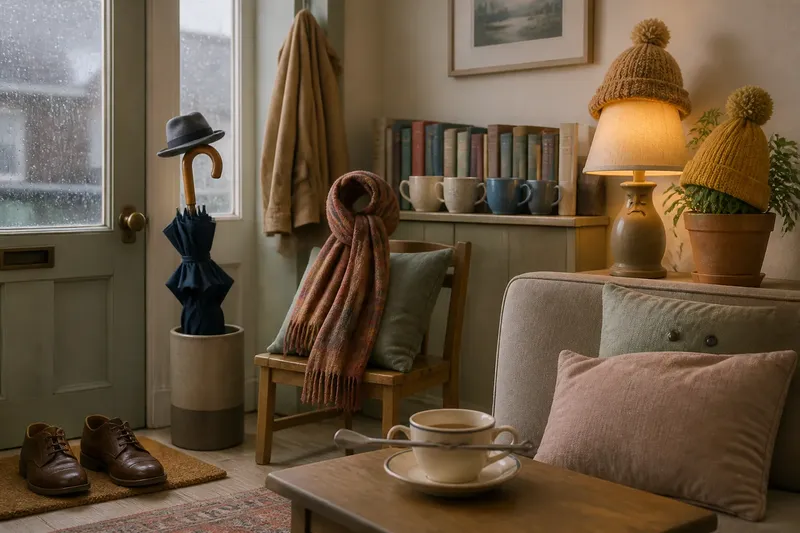
The common mistake in a rainy afternoon picture game is to demand a joke before anyone has looked around. That makes a quiet activity feel like an audition, and the objects seem stubborn by comparison. Start with one ordinary thing and notice how its placement changes the mood of the room.
How the game works
Choose an object, then invent a harmless situation around it. The pleasure is in treating a familiar thing as part of a small scene: a folded umbrella by the door might appear to be waiting for a late colleague, while a mug beside an empty chair could look like it has saved someone a seat.
Nothing needs to move. The object stays where it is; the imagined circumstances do the work. This is less a search for a hidden resemblance than a bit of casual scene-making, with the room as an unwilling set designer.
Choose a useful prop
Begin with something ordinary and easy to see: a coat hook, cushion, lampshade, slipper, plant pot or stack of books. Familiar objects offer a ready-made role to play against. A coat hook is meant to hold a coat; imagining it as a receptionist gives it a small change of status without requiring a complicated backstory.
Look at the object’s surroundings as well as the object itself. A pair of shoes near the doorway can suggest two guests who have arrived together. A row of books on a shelf may look like an audience waiting for the evening’s entertainment. The relationship between things can carry the scene.
- Shape: Does the object’s outline suggest a person, prop or familiar tool? If so, use that resemblance as the scene’s starting point; if not, look at its position or neighbours instead.
- Position: Is it tilted, isolated, tucked away or placed somewhere unexpected? If the placement suggests an action, build a situation around it; if it looks ordinary, choose another object.
- Neighbour: Does a nearby object seem to be addressing, avoiding or assisting it? If the pair suggests a relationship, give them a brief social situation; if not, consider a single-object role.
- Purpose: What is the object usually used for? If a different harmless job comes to mind, assign it that role; if the ordinary use already supplies enough amusement, leave it there.
- Room mood: Does the setting feel formal, hurried or cosy? If that atmosphere suggests a scene, use it; if the room offers no useful mood, let the object’s shape lead instead.
- Comfort: Does the idea depend on mocking a real person or a private difficulty? If it does, change the imagined situation; if it does not, carry on.
Pick the detail that catches your attention. The explanation can wait; the object has already done its part by being there.
Invent a small scene
Give the object a simple circumstance: a job, a social encounter, a minor predicament or an appointment it appears to have missed. Small scenes are easier to enjoy than elaborate stories. A scarf standing upright on a chair might seem to be supervising the room; it does not need a career history in local government.
Say you notice a teaspoon resting across a saucer. Imagine it has been assigned to guard the entrance to the cup. Its starting position supplies the prop, the imagined duty gives it a role, and the result is a tea setting that resembles a modest security checkpoint.
Other prompts can shift the kind of scene without turning the game into a writing exercise:
- A mistaken role: A coat stand appears to be conducting an orchestra of hanging coats.
- A social moment: Two slippers seem to have stopped speaking after an awkward disagreement.
- A small crisis: A plant pot looks as if it has been given a hat too large to manage.
- A formal occasion: A row of books appears to be waiting for an inspection.
- A failed plan: A cushion seems to have tried to hide behind another cushion and chosen a poor hiding place.
These are invented readings, not claims about what an object truly resembles. Keep the imagined action harmless; there is no need to make a real person the butt of the scene.
Let the room do more
Instead of trying to explain why an object is funny, ask what sort of scene its placement invites. A lamp beside a chair might look like a stern host keeping watch over a guest. Two mismatched cups on a table could seem to be waiting for a meeting that has been postponed. The surrounding objects supply a setting and a relationship, much as a stage set can suggest what happened before the curtain rose.
Try changing the imagined social situation rather than adding lore. A cushion on the floor could be a visitor who has been asked to sit anywhere; the same cushion beside a sofa might look like an understudy waiting for its cue. The room remains unchanged, but the object acquires a different part.
When an idea feels thin, look for another object to join the scene. When it becomes a long account of imaginary motives, return to what is physically present: the shapes, positions and nearby things. The room is a better scene partner than an invented biography.
Keep the game easy
Set a loose boundary: choose one object, invent a few different situations, then stop when attention starts to wander. You can play alone, take turns with someone else or keep the ideas to yourself. Scoring is unnecessary; the rules for awarding points to a suspicious lampshade remain unsettled.
If another person is playing, offer a scene rather than declaring the one correct interpretation. “That coat looks as if it is waiting for a train” leaves room for another idea. “It is obviously a train conductor” sounds less like play and more like a minor dispute with a coat.
For children, suggest harmless jobs or moods for the objects and keep the imagined actions safe. Adults can use the same prompts without treating whimsy as a technical requirement. A quiet response is still a response.
What questions arise?
Can I play without moving anything?
Yes. The object’s position, shape, shadow and neighbours are enough to suggest a scene. Leaving things in place also prevents a casual game from becoming an impromptu furniture rearrangement.
What if no scene comes to mind?
Try asking what the object might be waiting for, guarding or attending. If that draws a blank, choose another object or leave the thought alone; not every prop needs a speaking part.
Does every scene need to be funny?
No. A reading can be odd, tender or simply more expressive than the object’s ordinary use. Humour is welcome, but it is not a result due on a schedule.
How can I share an idea naturally?
Point out the object and offer one short imagined situation. Let the other person respond in their own way; a different scene may be more entertaining than the one you started with.
Know when to switch
Change objects when you keep assigning the same sort of role, when the room offers a more interesting prop or when the game starts to feel like work. A new object opens a different scene; it does not need to rescue the old one.
Imagine you have made a dented cushion the star of several increasingly solemn office dramas. You switch attention to a pair of shoes by the door and treat them as two guests who have arrived together. Their position suggests a shared entrance, giving you a fresh social scene rather than another chapter in the cushion’s career.
One good observation is enough. For another round of the rainy afternoon picture game, find an ordinary object and ask what small, harmless scene its place in the room might suggest.